

How to Spot the International Space Station
The ISS is one of the brightest objects in the night sky, and you can see it with your naked eye. Here's exactly how to find it — when to look, where to look, and what to expect.
The International Space Station is one of the brightest objects in the night sky — and you can see it without a telescope. Starglow tells you exactly when and where to look so you never miss a pass.
Download Starglow Free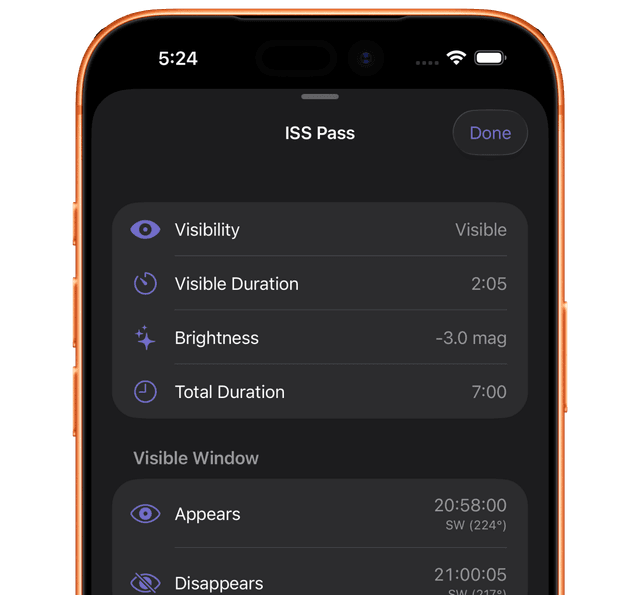
The International Space Station (ISS) is the largest human-made object in orbit. Spanning roughly the size of a football field, this orbital laboratory circles the Earth every 90 minutes at an altitude of approximately 250 miles (400 km). Since its first component launched in 1998, the ISS has been continuously occupied by rotating crews of astronauts conducting science experiments in microgravity.
What makes the ISS special for skywatchers is its size and reflectivity. Those massive solar panels reflect sunlight brilliantly, making the station one of the brightest objects visible in the night sky — often brighter than any star or planet. On a good pass, it's unmistakable: a steady, bright light gliding smoothly from horizon to horizon in just a few minutes.
ISS visibility depends on a precise alignment of conditions. The station must be passing over your area, your sky must be dark (after sunset or before sunrise), and the ISS must be in sunlight so it reflects light down to you. This creates specific visibility windows — typically in the 1-3 hours after sunset or before sunrise.
During the middle of the night, the ISS passes through Earth's shadow and becomes invisible, even when it's directly overhead. And during the day, it's washed out by sunlight. That narrow window around twilight is when the geometry works in your favor.
Starglow calculates all of this automatically for your location, showing you upcoming visible passes with their exact timing, how long they'll last, and how bright they'll appear.
Spotting the ISS is one of the easiest and most rewarding skywatching activities. Here's how to make the most of it:
Starglow provides several pieces of information for each ISS pass:
Starglow uses orbital data from space agencies to calculate exactly when the ISS will pass over your location. It factors in the station's orbit, your geographic coordinates, the time of day, and the Sun's position to determine whether the ISS will be visible — it needs to be in sunlight while your sky is dark. The app provides the start time, duration, maximum brightness, and direction for each pass.
The ISS is one of the brightest objects in the night sky, and you can see it with your naked eye. Here's exactly how to find it — when to look, where to look, and what to expect.
