
Cloud, seeing and transparency, hour by hour
A single cloud percentage hides the story. Starglow breaks the sky down layer by layer and hour by hour, with seeing, transparency and how many weather models agree, so you know before you pack the tripod.


Three layers, three different nights
The same “40% cloud” can be a wasted night or a perfectly usable one, depending on how high it is.
- Low cloud
- Below about 2 km. Blocks everything: fog, stratus and cumulus.
- Mid cloud
- About 2–6 km. Usually thick enough to hide all but the Moon and brightest planets.
- High cloud
- Above about 6 km. Thin cirrus: bright planets and the Moon shine through, but faint targets lose all contrast.
Every row that matters
One scrolling timeline, starting with sunlight, the Moon and ISS passes.
- Cloud cover
- Total, low, mid and high, every hour.
- Precipitation, visibility & wind
- Will it rain, how far you can see, and which way the wind is blowing for your setup.
- SeeingPro
- How steady the air will be, in arcseconds. Good seeing keeps planets and fine detail sharp.
- TransparencyPro
- How clear the air will be for faint galaxies and nebulae, from Poor to Excellent.
- Models ClearPro
- How many of six independent weather models forecast a clear sky each hour: your confidence in tonight.
- 5-day forecastsPro
- Sky conditions up to five days ahead instead of the next 48 hours.
Know when a clear night is coming
Clear Night alerts (Pro) are sent about three hours before dark when at least two dark hours tonight are forecast to be clear, and withdrawn if the forecast worsens. Choose Good or better, or Excellent only.
Pair them with the free Dark Sky, Moon and ISS alerts so you never miss a window.

Forecast the spot you're actually going
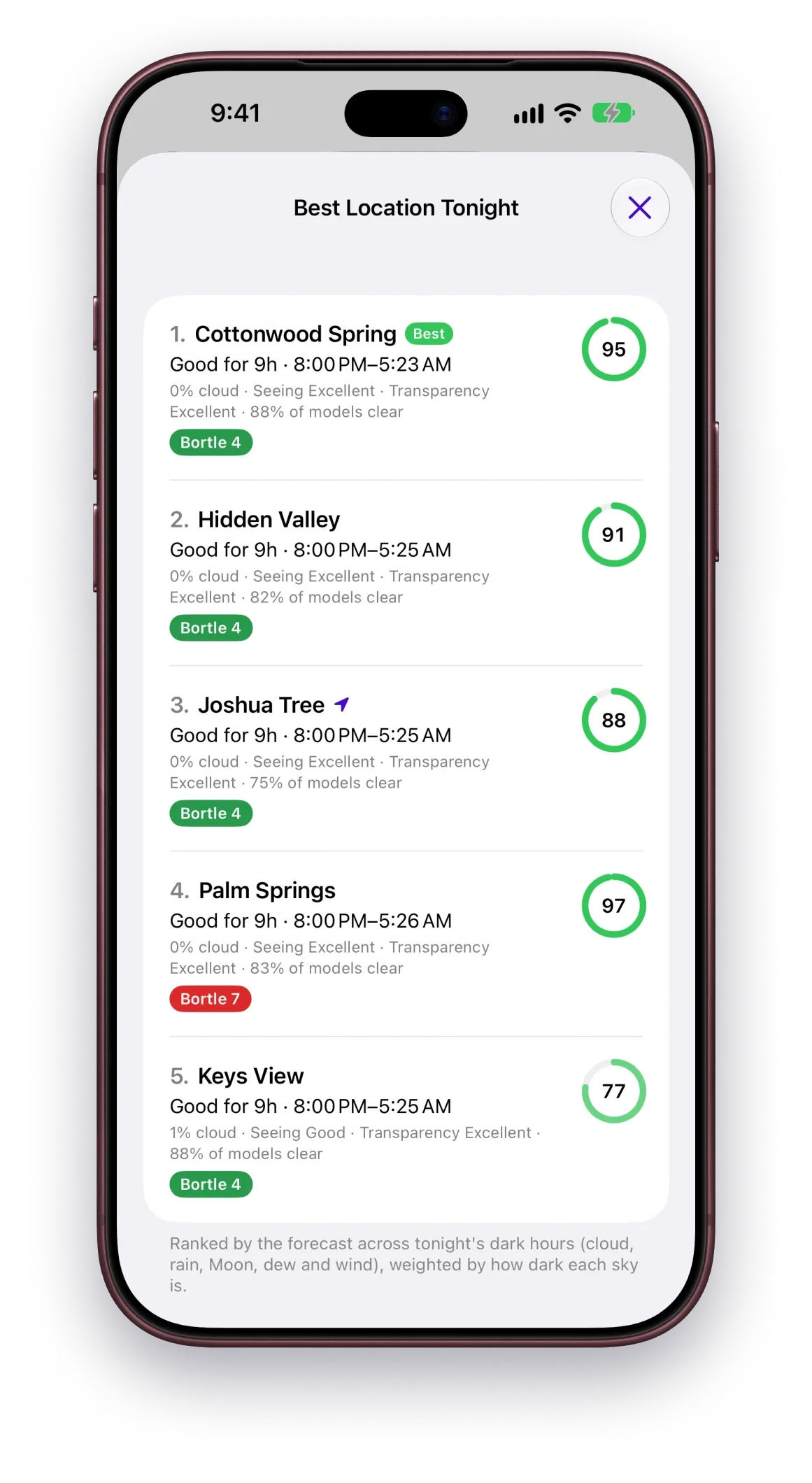
Your back garden isn't where you'll shoot. Search or pick any point on the map (a dark-sky park, a pass, a lake you're scouting) and Starglow forecasts for exactly there. With Pro, the places you pick are kept as recent locations, you can save up to ten favourite observing spots, and Best Location Tonight ranks them by tonight's sky.
Check where the Moon will be from the same place with the Moon direction map.
Get Starglow free on your iPhone
Cloud, the Moon, the ISS and darkness, hour by hour, with alerts when it matters.
Questions
Why does cloud altitude matter for astrophotography?
Different layers do different damage. Low cloud hides the sky completely, mid cloud blocks most targets, and thin high cirrus can let planets through while ruining long exposures of faint objects.
What are seeing and transparency?
Seeing is how steady the atmosphere is, measured in arcseconds (lower is better), and matters most for planets and the Moon. Transparency is how clear the air is, which matters most for faint deep-sky targets. Both are in Starglow Pro.
What does Models Clear mean?
Starglow Pro checks six independent weather models and shows how many of them forecast a clear sky each hour. 6/6 means they all agree; a split means tonight is less certain.
How far ahead does Starglow forecast?
The free forecast covers the next 48 hours, hour by hour. Starglow Pro extends it to five days.
Can Starglow tell me when a clear night is coming?
Yes. With Pro, Clear Night alerts are sent about three hours before dark when at least two dark hours are forecast to be clear, and withdrawn if the forecast worsens. Choose Good or better nights, or Excellent only.
Where to next
Moon Map & AR
Phase, moonrise, moonset and its path
ISS Passes
Visible passes, brightness, and AR paths
Milky Way & Dark Skies
Dark site finder, Vantage and star trails
Moon Direction Map
Moonrise, moonset and the Moon’s bearing for any place, free on the web
Starglow Pro
Everything Pro adds, next to what’s free
Download Starglow
Check tonight's sky before you head out.
Available on iPhone, iPad, Apple Watch & Apple Vision Pro.